
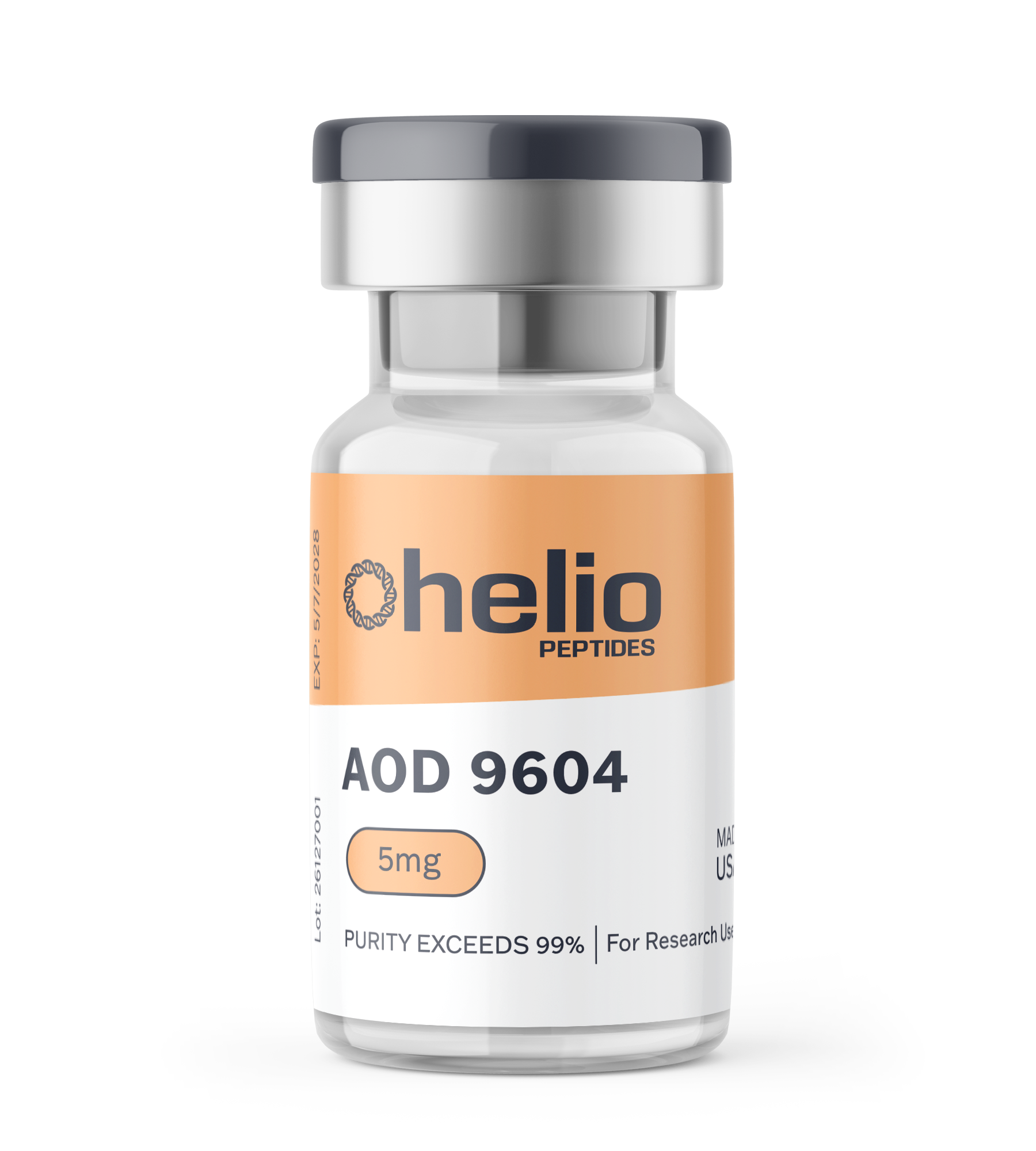
AOD-9604 is a synthetic 16-amino-acid peptide derived from the C-terminal region (residues 176–191) of human growth hormone (hGH), modified by the addition of a tyrosine residue at the N-terminus. Its sequence is YLRIVQCRSVEGSCGF, and it contains an internal disulfide bridge between the two cysteine residues (Cys7–Cys15). The molecule carries the formula C78H123N23O23S2 (≈81815.12 g/mol), CAS 221231-10-3, and PubChem CID 71300630. Because it corresponds to the lipolytic C-terminal fragment of hGH rather than the full hormone, it has been studied for effects distinct from the growth-promoting actions of intact growth hormone.
AOD-9604 was developed as part of research into the fat-metabolizing region of growth hormone, with the goal of isolating lipid-related activity from the broader metabolic and mitogenic effects of the parent hormone. In preclinical and in-vitro settings it has been used as a model peptide for studying adipocyte lipolysis and lipogenesis. It is supplied here solely as AOD-9604 research material for laboratory investigation.
YLRIVQCRSVEGSCGF
Research use only — not for human or animal consumption. Per-batch documentation is provided with the material.
AOD-9604 has been investigated in experimental and in-vitro settings as a fragment analog of the lipolytic C-terminus of human growth hormone. Studies report that the peptide can influence adipocyte metabolism — examined in the context of lipolysis and reduced lipogenesis — while, in the reported models, lacking the insulin-antagonizing and growth-stimulating effects associated with intact growth hormone.
Additional preclinical work has explored AOD-9604 in models of metabolic regulation and, separately, in connective-tissue and cartilage biology. All described observations derive from preclinical, experimental, or in-vitro systems and are presented strictly for research context, with no human efficacy implied.
AOD-9604 ("Anti-Obesity Drug 9604") was developed in the 1990s–2000s by researchers at Monash University in Australia, building on work identifying the C-terminal 176–191 region of human growth hormone as the domain associated with lipolytic activity. The N-terminal tyrosine modification was introduced to the native fragment, and the peptide was subsequently evaluated in a series of preclinical and early clinical metabolic studies.
View compound profile on NIH PubChem →
Cited literature refers to laboratory and preclinical research. AOD-9604 is supplied strictly for research use only and is not intended to diagnose, treat, cure, or prevent any disease.