
Research Use Only / Third-Party Analytical Testing / Per-Batch Documentation / Materials Shipped from the USA
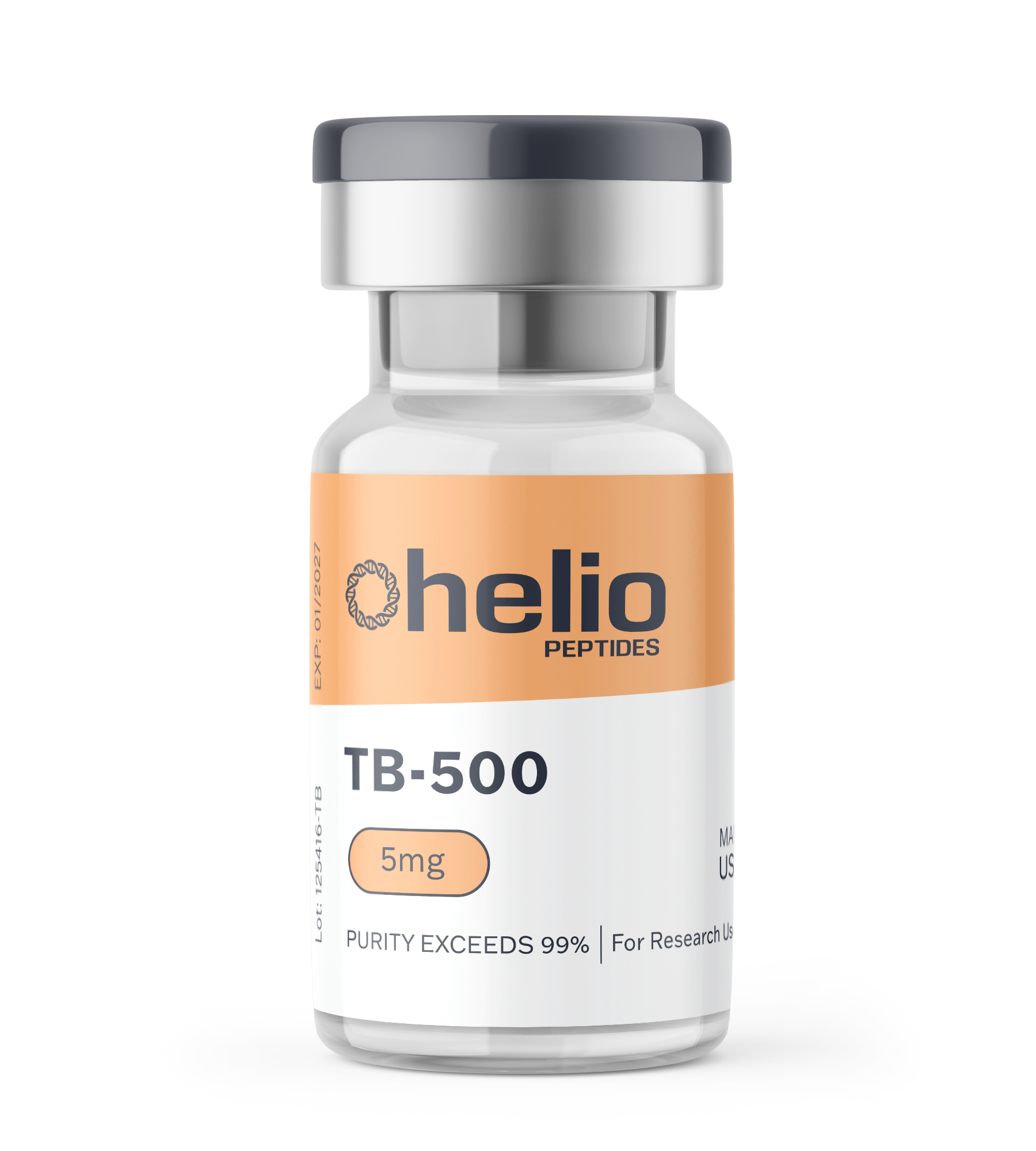
TB-500 research material
Vial · Research materialHelio®
Recovery Research

TB-500

TB-500 is the research designation associated with Thymosin Beta-4 (Tβ4), a naturally occurring 43-amino-acid peptide and the principal G-actin-sequestering molecule in mammalian cells. As commonly supplied, the full-length peptide carries an N-terminal acetyl group and the sequence Ac-SDKPDMAEIEKFDKSKLKKTETQEKNPLPSKETIEQEKQAGES, corresponding to molecular formula C212H350N56O78S, molecular weight approximately 4963 g/mol, CAS 77591-33-4 and PubChem CID 16132341. Note that some literature applies the "TB-500" name to a shorter active fragment; Helio material corresponds to the full-length Thymosin Beta-4 sequence.

Thymosin Beta-4 has been studied for roles in actin regulation, cell migration, angiogenesis and tissue repair. Its seven-residue actin-binding motif has been identified as essential for angiogenic activity. Helio supplies TB-500 as a lyophilized powder in 5 mg vials. This material is offered for Research Use Only and is not intended for human or veterinary use.

Identification
  • MaterialTB-500
  • Research AreaRecovery
  • PresentationVial
  • Available Sizes5mg
  • CAS Number77591-33-4
  • Molecular FormulaC212H350N56O78S
  • Molecular Weight4963.44 g/mol
  • TypeSynthetic 43-residue peptide (full-length Thymosin Beta-4)
  • Receptor / TargetNo classical membrane receptor; primary molecular target is monomeric G-actin (actin-sequestering), with pro-angiogenic activity localized to the actin-binding motif
  • PubChem CID16132341 →
Amino Acid Sequence

Ac-Ser-Asp-Lys-Pro-Asp-Met-Ala-Glu-Ile-Glu-Lys-Phe-Asp-Lys-Ser-Lys-Leu-Lys-Lys-Thr-Glu-Thr-Gln-Glu-Lys-Asn-Pro-Leu-Pro-Ser-Lys-Glu-Thr-Ile-Glu-Gln-Glu-Lys-Gln-Ala-Gly-Glu-Ser-OH (N-acetylated, 43 aa)

Analytical Data
  • Purity (HPLC)≥99%
  • Identity (MS)Confirmed to specification
  • TestingAccredited (ISO 17025) third-party laboratory
  • DocumentationPer-batch COA →
From$39.95
Currently unavailable

Research use only — not for human or animal consumption. Per-batch documentation is provided with the material.

Key Characteristics
Molecular FormulaC212H350N56O78S
Molecular Weight~4963.44 g/mol
CAS Number77591-33-4
PubChem CID16132341
StructureLinear N-acetylated 43-residue peptide (full-length Thymosin Beta-4)
Receptor / TargetMonomeric G-actin (actin sequestration); angiogenic activity via the actin-binding motif
FormLyophilized powder (vial)
SolubilitySoluble in water and bacteriostatic water
StorageStore lyophilized at -20°C; reconstituted material at 4°C short-term, -80°C long-term
StabilityStable as lyophilized powder; protect from light and minimize freeze-thaw cycles in solution
Research Context
Actin regulationPrimary molecular action is sequestration of monomeric G-actin, modulating cytoskeletal dynamics.
Cell migrationStudied for promotion of keratinocyte, fibroblast and endothelial cell migration during repair.
AngiogenesisThe seven-residue actin-binding motif has been shown essential for pro-angiogenic activity.
Wound healingExamined in dermal and corneal wound models for reepithelialization and collagen deposition.
Cardiac & tissue repairInvestigated in cardiac injury and other tissue-regeneration models.
Research Findings

Thymosin Beta-4 is characterized in the literature primarily as an actin-sequestering peptide that "moonlights" as a tissue-repair factor. Studies including Malinda et al. (1999) reported accelerated reepithelialization, angiogenesis and collagen deposition in rodent dermal wound models, while Grant and colleagues demonstrated that the actin-binding site is required for angiogenic activity.

These findings derive from animal and in-vitro experiments and describe an endogenous peptide's biology; controlled human efficacy for the research compound has not been established. Data should be treated as experimental.

History

Thymosin Beta-4 was originally isolated from thymus tissue and later recognized as the major intracellular actin-sequestering peptide; it has been studied since the 1980s-1990s for actin regulation and wound healing. In the research-peptide market the "TB-500" name became attached to this sequence (and to a related active fragment). It remains an unapproved investigational compound for laboratory research only.

References
  1. Malinda KM, Sidhu GS, Mani H, et al. Thymosin beta4 accelerates wound healing. Journal of Investigative Dermatology. 1999;113(3):364-368.
  2. Philp D, Kleinman HK. Animal studies with thymosin beta4, a multifunctional tissue repair and regeneration peptide. Annals of the New York Academy of Sciences. 2010;1194:81-86.
  3. Goldstein AL, Hannappel E, Kleinman HK. Thymosin beta4: actin-sequestering protein moonlights to repair injured tissues. Trends in Molecular Medicine. 2005;11(9):421-429.
  4. Bock-Marquette I, Saxena A, White MD, et al. Thymosin beta4 activates integrin-linked kinase and promotes cardiac cell migration, survival and cardiac repair. Nature. 2004;432(7016):466-472.

View compound profile on NIH PubChem →

Cited literature refers to laboratory and preclinical research. TB-500 is supplied strictly for research use only and is not intended to diagnose, treat, cure, or prevent any disease.
Why researchers choose Helio
99%+ PurityHPLC-verified every batch
Accredited TestingIndependent ISO 17025 laboratory
Per-Batch COADocumentation tied to your lot
Made in the USADiscreet, protected shipping
Related

More in Recovery

View area